BYS
BYS Türkçe
Ottoman Ḥadīth Symposium
HOME
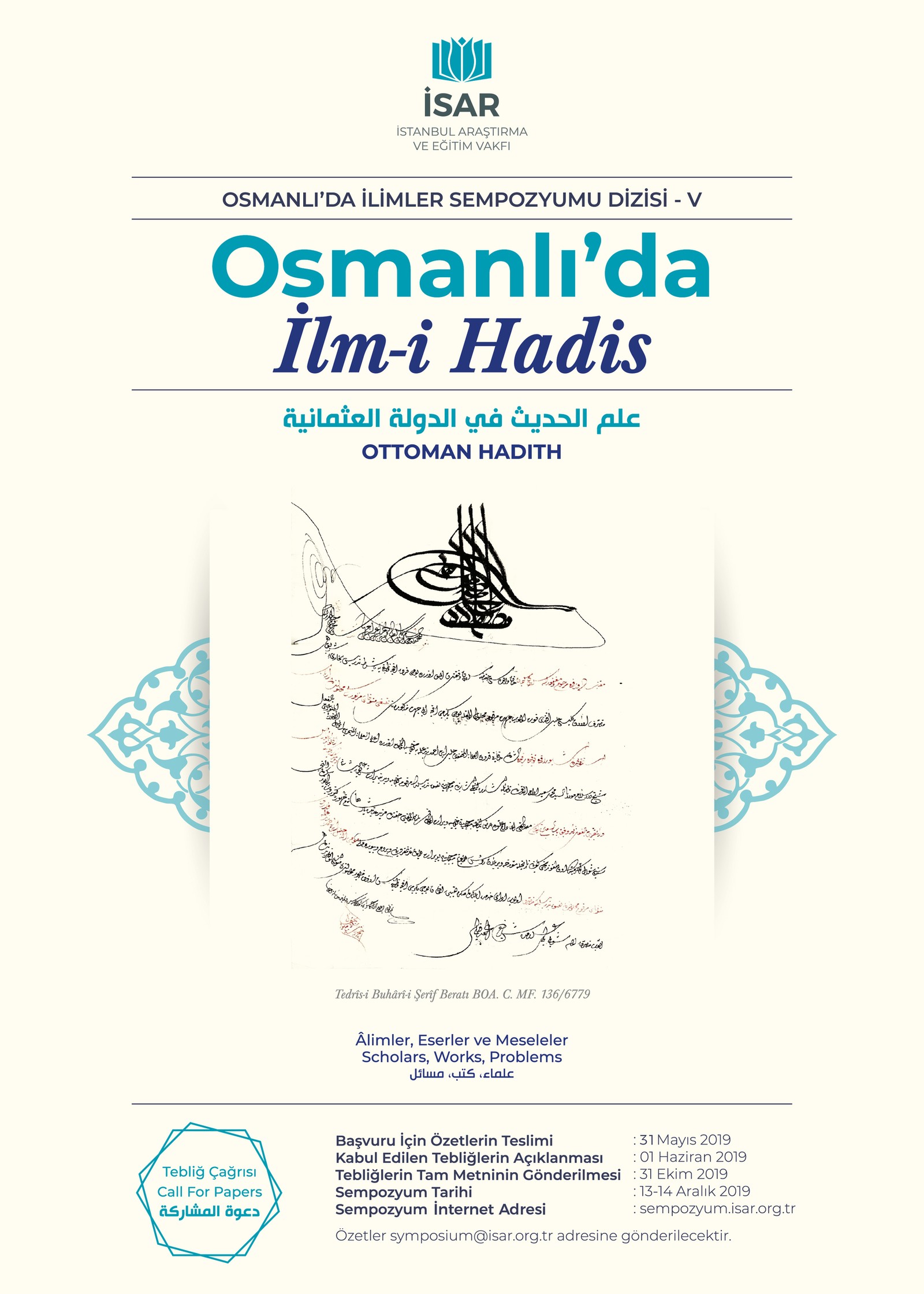
IMPORTANT DATES
Important Dates
Deadline to submit abstracts: May 31, 2019
Announcement of accepted papers: June 01, 2019
Deadline to submit full texts: September 31, 2019
Symposium date: December 13-14, 2019
BOARDS
Organizing Committee
Prof. Dr. Zekeriya GÜLER
Prof. Dr. Bekir KUZUDİŞLİ
Dr. Ahmad Abduljabbar SNOBAR
Dr. Hamzeh AL-BAKRI
Res. Asst. Dr. M. Celil ALTUNTAŞ
Muhammed Ali BÜYÜKSOYLU
Abdullah Rıdvan GÖKBEL
CONTACTS
İSTANBUL ARAŞTIRMA VE EĞİTİM VAKFI
Adres: Selami Ali Mahallesi. Selanikliler Sokak. No:44/1 Üsküdar İstanbul, Türkiye
Tel : + 90-216-310 99 20 Fax : + 90 216 391 26 33
sempozyum@isar.org.tr
sempozyum.isar.org.tr
CALL FOR PAPERS
ISAR Ottoman Sciences Symposium Series V
Ottoman Ḥadīth: Scholars, Works, Problems
The established understanding dominant in academic studies on Islamic culture and civilization is based on the assumption that Islamic thought had lost its productivity since the Middle Ages. As a consequence of this viewpoint, it became widely accepted that the field of Islamic sciences during the Ottoman period, which spanned from the Middle Ages to the modern era, was a period marked by stagnation. In recent years, however, revisionist/critical studies have begun to question these assumptions. Beyond reductionist conceptualizations and the usage of contentious terms such as productivity and stagnation in reference to the Ottoman era of Islamic knowledge and culture, there is a pressing need for academic works that aim to understand the Ottoman tradition in its own context. To this end, ISAR put together a series of scholarly forums aimed at redefining the place of the Ottoman scholarly tradition in the context of both the Islamic sciences and global intellectual history through a multi-layered approach. The first four symposiums of the series were devoted to the sciences of Kalām, Fiqh, Sufism and Tafsīr. The fifth meeting of the series will focus on the Ottoman Ḥadīth tradition.
The science of Ḥadīth which aimed to reliably transmit to later periods the sayings and actions of the Prophet alongside that of the first generation has continued through various activities in every period of history. Activities of which we may refer to as the verification and transmission of Ḥadīth had evinced considerable development in early periods during which foundational works on Ḥadīth were penned. After the first three centuries known as the age of narration one of the first examples of works on the methodology of Ḥadīth (uṣūl al-ḥadīth) and commentaries (sharḥ) of which were intended to explicate ḥadīths had appeared. Moreover, soon after these foundational works were written, works characterized as compilations were authored and used as a basis for Ḥadīth instruction. In the sixth-century, with the establishment of the dār al-ḥadīths, it may be said that this marked, in an institutional sense, a new era in Ḥadīth history. Together with this institutionalization advances were made during the Mamluk period in almost every area in the science of Ḥadīth, a period which saw the authorship of the most developed works in the sub-branches of Ḥadīth.
One of the areas that needs to be addressed when it comes to the Ottomans, who appeared on the stage of history during the period in which the Mamluks had ruled Egypt, is the extent to which they inherited this accumulation of knowledge. Alongside this, the magnitude of concern displayed by the Ottoman scholars who had come into contact with the works and students of scholars from the regions of Transoxania and Khurasan is another area that needs to be examined. Furthermore, madrasahs and dār al-ḥadīths were constructed in every region that the Ottoman Empire had conquered. The instruction of Ḥadīth in these institutions as well as the scale of its impact on the development of Ḥadīth can be considered among the subjects that will shed light on the Ottoman period.
In addition to the instruction of Ḥadīth in madrasahs, examining the activities carried out on the conveyance of Ḥadīth to the wider segments of society will reveal more clearly the import of Ḥadīth in Ottoman society. Literary works on sermons and the sort of works that were shaped around the love of the Prophet such as the Shamā’il, Hilya, and Na‘t are some examples where ḥadīths were used in relation to this subject. Likewise, ḥadīths that were discussed in poetic literature, architecture, and art indicate that Ḥadīth, beyond being a pure science, was a field that was intertwined with the culture of the society. In this context, Ḥadīth in the Ottoman period is a field that must be treated together with other scholarly disciplines such as Taṣawwuf, Literature, and Philosophy. This is because commentaries on Ḥadīth that were authored during this period contained interpretations that brought together these different disciplines.
Another issue that will better clarify the position of Ḥadīth in the Ottoman period are the ḥadīth collections and the authorized ḥadīth books that had been brought to Istanbul and were accumulated in libraries independently established during the 17th century. Ḥadīth in the Hijaz, which was revived during the 18th century, together with the link between scholars in this region and Ottoman administrators and scholars will provide insight into the state of Ḥadīth in the Ottoman Empire. The increasing ḥadīth ijāzahs during this period and its effects in Istanbul will undoubtedly create new avenues in understanding the link between the ulema in the Ottoman center with scholars based in different geographies.
Submissions of original research on the topics listed below will be accepted to be presented at the symposium. The topics, however, are not limited to these as papers of original quality related to Ḥadīth in the Ottoman period will be taken into consideration.
Relations between Ḥadīth scholars in the Mamluk period
Ḥadīth interpretation in the early Ottoman period
Ḥadīth translations in the Ottoman period
Works on the methodology of Ḥadīth (uṣūl al-ḥadīth) in the Ottoman period
Ḥadīth ijāzahs and the link between the Ottoman ulema and Ḥadīth scholars
Usage of ḥadīth, poetic ḥadīth literature, and forty-ḥadīth (arba‘ūn) in sermon literature
Ḥadīth and its connection with Sufism, Literature, and other religious sciences
Instruction of Ḥadīth in madrasahs and dār al-ḥadīths
Increase in Ḥadīth activities in the Hijaz-Sham route and the link between Ottoman scholars and administrators with the ulema in this region
Ḥadīth works presented to Sultans and the link between administrators and Ḥadīth
Ḥadīth and Ḥadīth personalities in biographical literature of the period and works on the classification of sciences
Importance of Ḥadīth in Anatolian and Istanbul libraries and the transportation of valuable ḥadīth manuscripts to Istanbul
Sunni-Shia interaction in the Ottoman period
Following the symposium, papers will be selected and published as a separate work.
The symposium will be held in Istanbul. The language of the symposium will be in Turkish, English, and Arabic.
Abstracts should not exceed 250 words.
Abstracts - together with the applicants’ contact information and academic CVs - should be sent to symposium@isar.org.tr.
ORGANIZATION COMMITTEE
organization committee:
Prof. Dr. Zekeriya GÜLER
Prof. Dr. Bekir KUZUDİŞLİ
Dr. Öğr. Üyesi Ahmad Abduljabbar SNOBAR
Dr. Öğr. Üyesi Hamzeh AL-BAKRI
Arş. Gör.Dr. M. Celil ALTUNTAŞ
Muhammed Ali BÜYÜKSOYLU
Abdullah Rıdvan GÖKBEL
SCIENCE BOARD
Science Board:
- Abdullah Aydınlı (Sakarya Üniversitesi)
- Abdullah Karahan (Uludağ Üniversitesi)
- Abdullah Taha İmamoğlu (Trakya Üniversitesi)
- Ahmed Snobar (29 Mayıs Üniversitesi)
- Ahmet Yücel (29 Mayıs Üniversitesi)
- Ayşe Esra Şahyar (Marmara Üniversitesi)
- Bekir Kuzudişli (İstanbul Üniversitesi)
- Beşir Avvad Maruf (The World Islamic Sciences and Education University)
- Bünyamin Erul (Ankara Üniversitesi)
- Devin Stewart (Emory University)
- Emin Aşıkkutlu (Trabzon Üniversitesi)
- Erdinç Ahatlı (Sakarya Üniversitesi)
- Halit Ozkan (Şehir Üniversitesi)
- Hamza Bekri (İbn Haldun Üniversitesi)
- Hüseyin Hansu (İstanbul Üniversitesi)
- Jonathan Brown (Georgetown University)
- M. Emin Özafşar (Ankara Üniversitesi)
- Mâcid Derviş (Jinan University)
- Macit Demirer (Bolu Abant İzzet Baysal Üniversitesi)
- Mehmet Eren Necmettin Erbakan Üniversitesi
- Mehmet Özşenel (Marmara Üniversitesi)
- Mutaz al-Khatib (Hamad Bin Khalifa University)
- Muhammet Beyler (Yalova Üniversitesi)
- Muhittin Uysal (Necmettin Erbakan Üniversitesi)
- Mustafa Celil Altuntaş (İstanbul Üniversitesi)
- Mustafa Sheikh (University of Leeds)
- Mürteza Bedir (İstanbul Üniversitesi)
- Naci Lemin (Dar el-hadith el-Hassania)
- Raşit Küçük (İslam Araştırmaları Merkezi)
- Salih Karacabey (Yozgat Bozok Üniversitesi)
- Selahattin Yıldırım (Kırklareli Üniversitesi)
- Seyit Avcı (Selçuk Üniversitesi)
- Yakup Koçyiğit (Karabük Üniversitesi)
- Yavuz Ünal (Ondokuz Mayıs Üniversitesi)
- Zekeriya Güler (29 Mayıs Üniversitesi)
- M. Issam Eido (Vanderbilt University)
PROGRAM ve KİTAPÇIK
.jpg)
.jpg)