BYS
BYS Türkçe
Ottoman Sufism: Scholars, Works, and Problems
Home
CALL FOR PAPERS
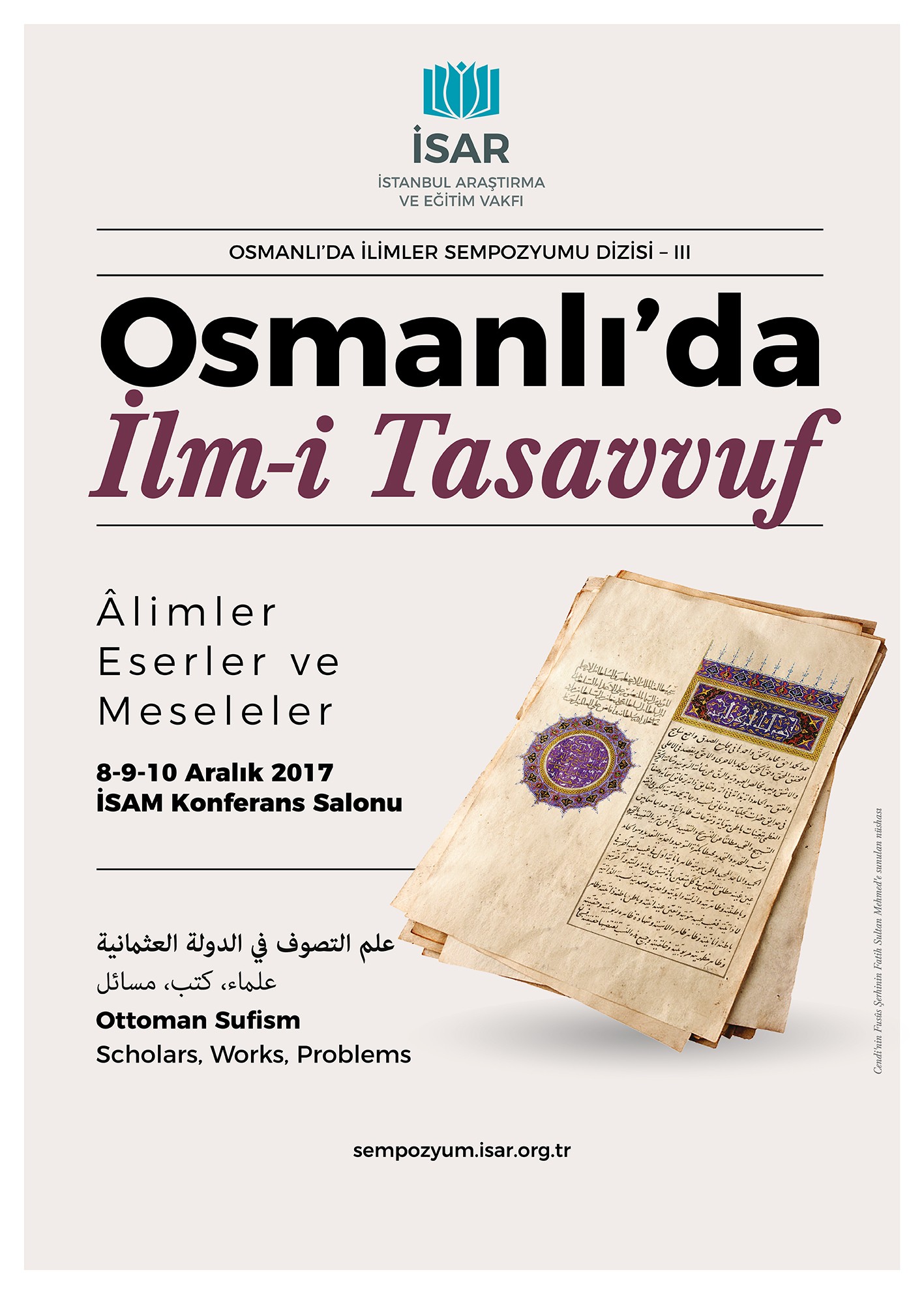
Ottoman Sufism: Scholars, Works, and Problems
The established understanding dominated by academic studies on Islamic culture and civilization rests on the assumption that Islamic thought had lost its productivity from the middle ages onwards. As a result of this perspective, it became widely accepted that the field of Islamic sciences during the Ottoman epoch which spanned from the middle ages continuing on until the modern era was, with the most optimistic of expressions, a stationary period. In recent years, however, revisionist/critical studies have begun to question these assumptions. Beyond reductionist conceptualizations as in productivity and stagnation of the knowledge and cultural heritage of the Ottoman period, there is a need for studies which aim to understand the Ottoman tradition in its own context. ISAR put together a series of scholarly forums aimed at redefining the place of the Ottoman scientific tradition by considering the Ottoman scholarly tradition as an extension of this approach with a multi-layered understanding. The first two symposiums of the series were devoted to the sciences of kalām and fiqh. The third forum of the series will focus on the sufi tradition of the Ottoman period. Sufism (Taṣawwuf) is a sphere of activity that reinterprets issues of metaphysics as well as reconstructs morality from the viewpoint of sincerity and rectitude in relation to the relationship between God and the human being, and is thus a source of different perspectives within the aggregate formed by Islamic sciences. Sufism which has become an integral part of social structure with the spread of the ṭarīqahs (Sufi currents), and has developed reflexes in response to the multi-faceted expectations of the social segments oriented towards itself, and thus has been active in political relations as much as in everyday relations alongside in the forms of religiousness and the issues of Islamic theoretical heritage. The Sufi experience which has left a mark in all cultural manifestations stands as an area of research that is suitable for rereading, taking into consideration various stages in the history of Islamic sciences. The Ottoman phase in the history of Islamic sciences corresponds to a historical range which reflects the fundamental characteristics of sufism in a multi-faceted way with its theoretical and practical aspects. As a matter of fact, Ottoman Sufis have on the one hand kept alive the conceptual repertoire of the theoretical heritage with the works they wrote, and on the other hand created an educational field that found their institutional identities in the tekkes (Sufi lodges) and practically exemplified sufi perspective of the human being. From today's perspective, whether with its conceptual expansions or its discovered areas of application in history, evaluating the Ottoman Sufi tradition requires an interdisciplinary effort. This study does not stop at simply making an important contribution to Sufi studies, but will also broaden the perspective of researchers who study Ottoman history by noting the widespread influence sufism has. For this reason, the examination of the religious and social dimensions of sufism in the Ottoman Empire can only be possible through the joint efforts of different disciplines such as history, literature, and philosophy. This symposium, which focuses on the Ottoman period of Sufi history and aims to open up new viewpoints to the present scholarship, will accept original and high quality papers within the following sample headings:
- The Ottoman Sufi experience in general and its place in Sufi history and thought
- Textual and ritual contributions to the theory and practice of sufism in the
Ottoman geography
- Commentaries, glosses, treatises and translations of classical texts into Ottoman
Turkish
- The basic polemics that took place within Sufi thought and institutions: Debates
of oneness of being (waḥdat al-wujūd), discussions of sema-devran, the orthodoxy-heterodoxy dilemma
- Relations between Sufi groups and other scholars
- The harmony and tension between Sufi circles and the ruling elite
- The interaction between sufism and the Ottoman political tradition
- Perception of sufism in texts of other Islamic sciences (kalām, philosophy, fiqh, etc.)
- The science of taṣawwuf in relation to the place of Sufis in Ottoman social life
Following the symposium, only papers selected from those presented will be published as a separate work.
The languages that shall be used for the symposium in Istanbul are Turkish, English and
Arabic.
Abstracts must be written with a maximum of 250 words.
Abstracts - together with applicants' contact information and academic CVs - should be
sent to symposium@isar.org.tr.
IMPORTANT DATES
Important Dates:
Submission of Abstracts: April 15, 2017
Announcement of Accepted Presentations: April 30, 2017
Submission of Completed Papers: October 15, 2017
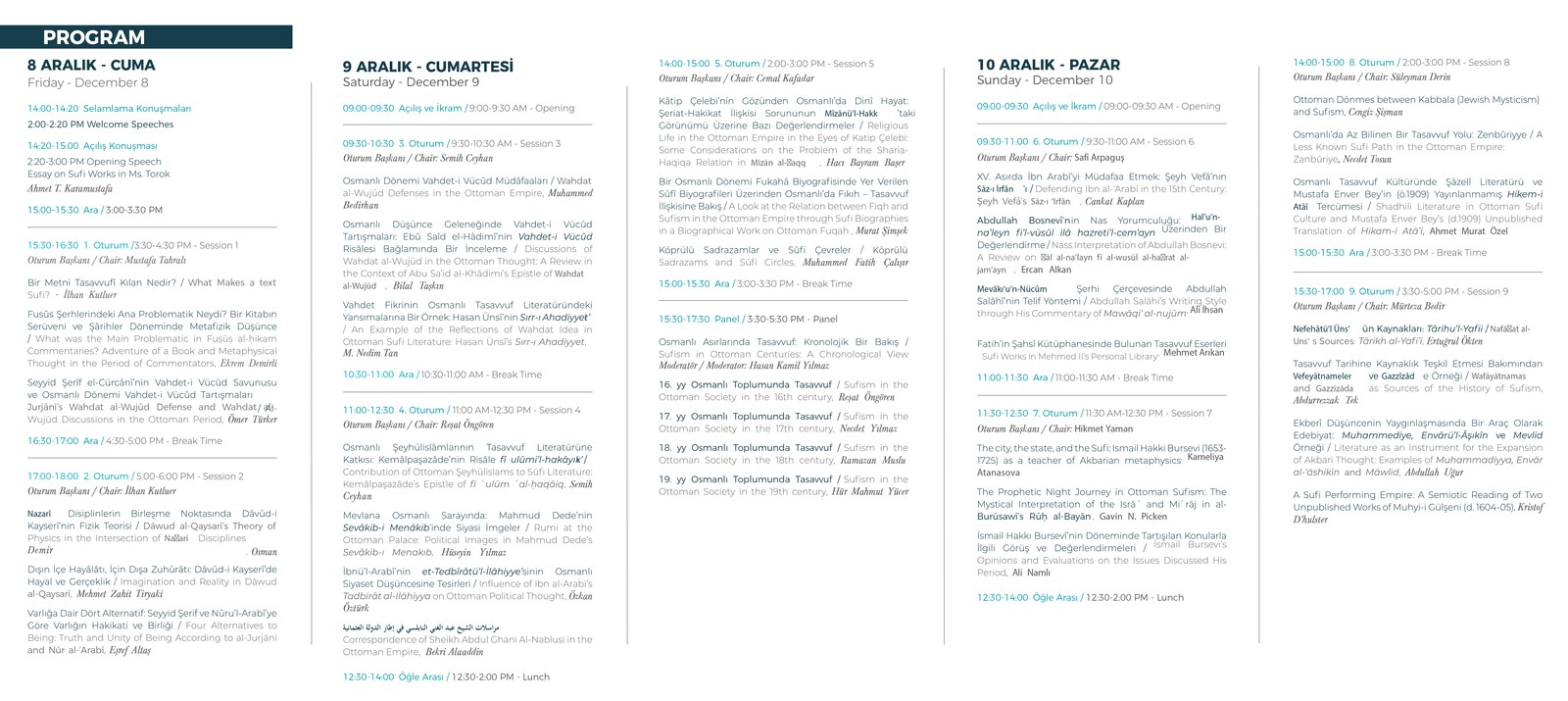
Date of Symposium: 9-10 December 2017
CONTACTS
İSTANBUL ARAŞTIRMA VE EĞİTİM VAKFI
Adres: Selami Ali Mahallesi. Selanikliler Sokak. No:44/1 Üsküdar Istanbul, Turkey
Tel : + 90-216-310 99 20 Fax : + 90 216 391 26 33
sempozyum@isar.org.tr
sempozyum.isar.org.tr
Secretary
Secretary
Ali İhsan Kılıç
Abdullah Rıdvan Gökbel
Furkan Mehmed
SCIENCE BOARD
SCIENCE BOARD
Ahmed Abdelmeguid (Syracuse University)
Ahmet Karamustafa (University of Maryland)
Ali Namlı (Marmara Üniversitesi)
Bakri Aladdin (IFEAD - Institut Français d'Etudes Arabes de Damas)
Ekrem Demirli (İstanbul Üniversitesi)
Ercan Alkan (Marmara Üniversitesi)
H. Bayram Başer (Yalova Üniversitesi)
H. Kamil Yılmaz (Marmara Üniversitesi-İstanbul Müftülüğü)
Hikmet Yaman (Marmara Üniversitesi)
Hür Mahmut Yücer (Karabük Üniversitesi)
Hüseyin Yılmaz (George Mason University)
İrfan Gündüz (İbn Haldun Üniversitesi)
Mustafa Tahralı (29 Mayıs Üniversitesi)
Mustapha Sheikh (University of Leeds)
Mürteza Bedir (İstanbul Üniversitesi)
Necdet Tosun (Marmara Üniversitesi)
Necdet Yılmaz (İstanbul Üniversitesi)
Nurullah Koltaş (Trakya Üniversitesi)
Osman Sacid Arı (İstanbul Üniversitesi)
Ramazan Muslu (İstanbul Üniversitesi)
Recep Şentürk (İbn Haldun Üniversitesi)
Reşat Öngören (İstanbul Üniversitesi)
Safi Arpaguş (Marmara Üniversitesi)
Samer Akkach (The University of Adelaide)
Semih Ceyhan (Marmara Üniversitesi)
Serhan Afacan (Medeniyet Üniversitesi)
Süleyman Derin (Marmara Üniversitesi)
PROGRAM VE KİTAPÇIK